
Ravine vs Howard Leight: Is It Time to Retire the Impact Sport?
 Mike22 September 2026
The Impact Sport is the electronic muff a lot of shooters start with, because it's inexpensive and the original runs on two AAA batteries you can buy at any gas station.
We compare two versions here, the original and the Bluetooth model, and both sit over your head, so the question on this page is whether to move from a muff to an earbud at all.
Every Howard Leight figure below is from Howard Leight's own product pages, with the date we read it.
1. Ravine FieldOps Pro
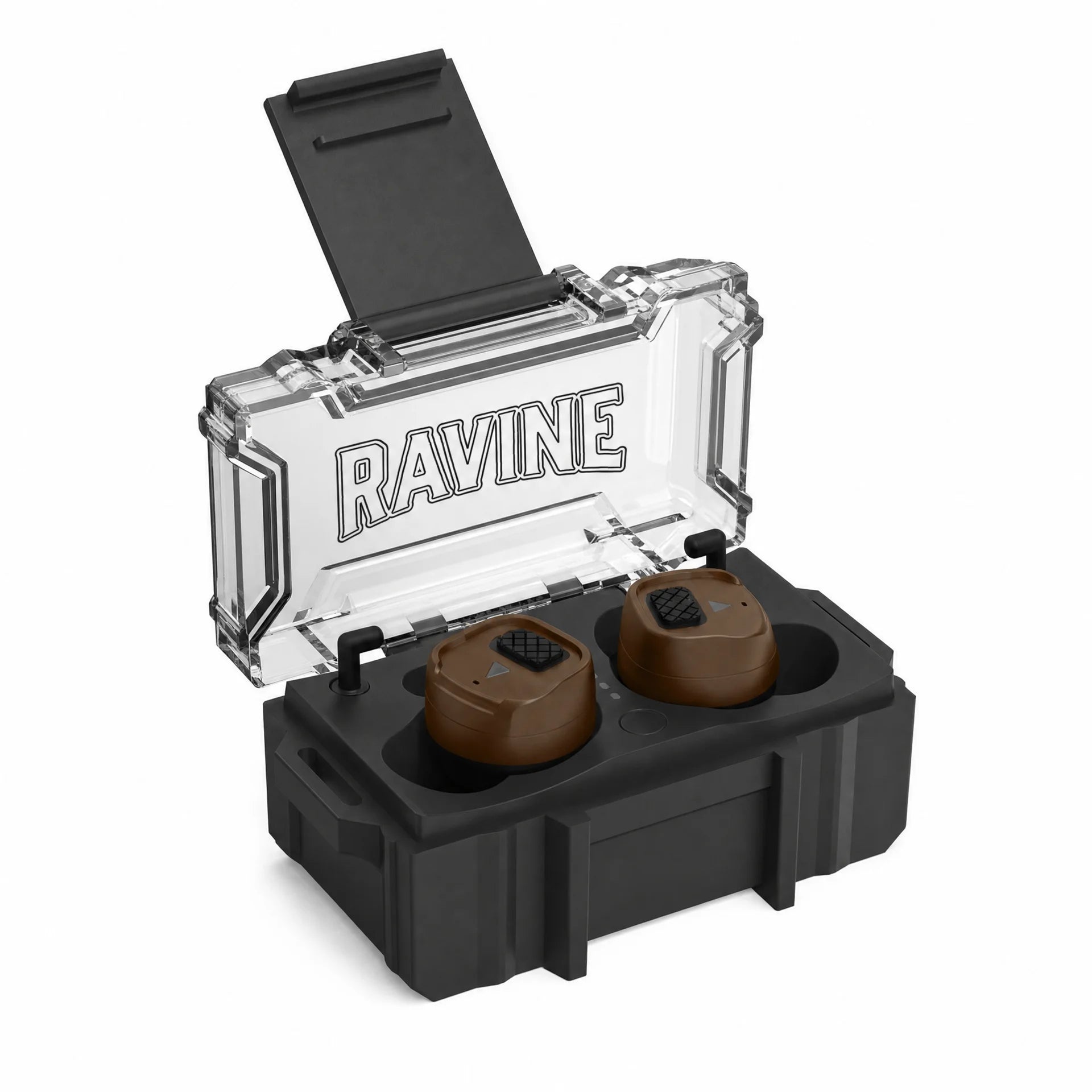
In-ear, clear of the cheek weld, rated 31 dB on the Pro, and 40 hours with the case.
The Impact Sport wins on price, and the original is about as simple as electronic protection gets. The FieldOps Pro sits in your ear, so there's no cup against your cheek when the gun comes up and no headband to wear under a hat, and it recharges in its case, where the original Impact Sport takes AAA batteries.
| Noise Reduction Rating | 31 dB on the Pro, 27 dB on the standard |
| Response time | 0.01 seconds |
| Compression triggers at | 82 dB |
| Amplification | turns up quiet ambient sound in outdoor mode |
| Battery | 40 hours with the charging case |
| Price | $239.99 Pro, $199.99 standard |
Every electronic pair here does the same job in principle: a microphone listens, and when something crosses 82 dB the chip pulls the volume down before it reaches your ear.
What separates them is how fast, and what happens afterwards. Ravine quotes 0.01 seconds. The pairs that feel worst on a range day are not the ones with the lowest rating, they are the ones that stay ducked for a second after the shot, so you lose the conversation and the next bird.
The standard FieldOps is rated 27 dB and the Pro is 31 dB. Those are Noise Reduction Ratings, the figure the EPA requires on the label, measured in a laboratory on a fitted ear.
A rating is a ceiling, not a promise. A pair rated four decibels higher that will not stay in your ear protects you less than a pair rated lower that does. That is the whole argument for the in-ear form, and it is why fit sits above rating in this ranking.
It is also why several makers here publish a range rather than a number: the rating moves with the ear tip you put on.
Amplification is the half people forget. Ravine lifts ambient sound, which is what you want when the thing you are listening for is a twig at forty yards.
This is not a hearing aid and it is not sold as one. It is a microphone and a speaker, tuned for the sounds you go out to hear. If your hearing has changed enough to affect conversation, see an audiologist, and do that whether or not you buy anything here.
The FieldOps Pro is $239.99 and the standard FieldOps is $199.99. Those are the single-pair prices at the cart, not a per-unit price pulled out of a multi-pair bundle.
Both come with a 30-day money-back guarantee, and Ravine attaches no conditions to it.
Hunters who need to hear the approach and still have ears at the end of the season, and anyone who has given up on muffs because of the cheek weld.
If you spend your year on an indoor range and never need to hear anything between strings, a good muff is cheaper and does that job.
THE EARBUD IN THIS COMPARISON
In-ear, clear of the cheek weld, 40 hours with the case. $239.99 with a 30-day money-back guarantee.
SEE THE FIELDOPS PRO >>2. Howard Leight Impact Sport
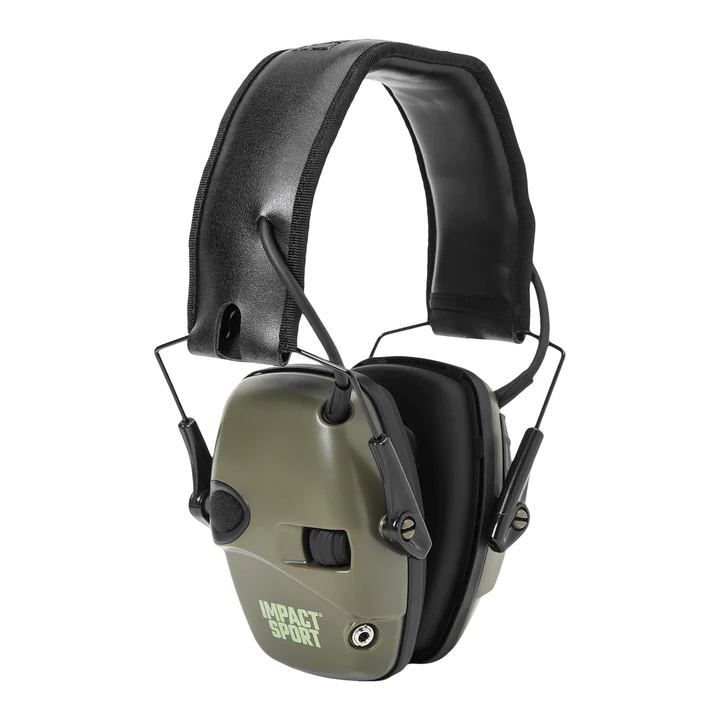
Howard Leight Impact Sport
From the maker's own page, read 2026-09-22Directional microphones turn range commands and other ambient sound up to 82 dB and stop amplifying above it, the slim cups clear a rifle stock, and it runs about 350 hours on two AAA batteries, with an AUX input for a radio or music.
An over-the-head muff rather than an in-ear device, with no Bluetooth, and its rating sits toward the lower end of the electronic protection compared on these pages.
3. Howard Leight Impact Sport Bluetooth
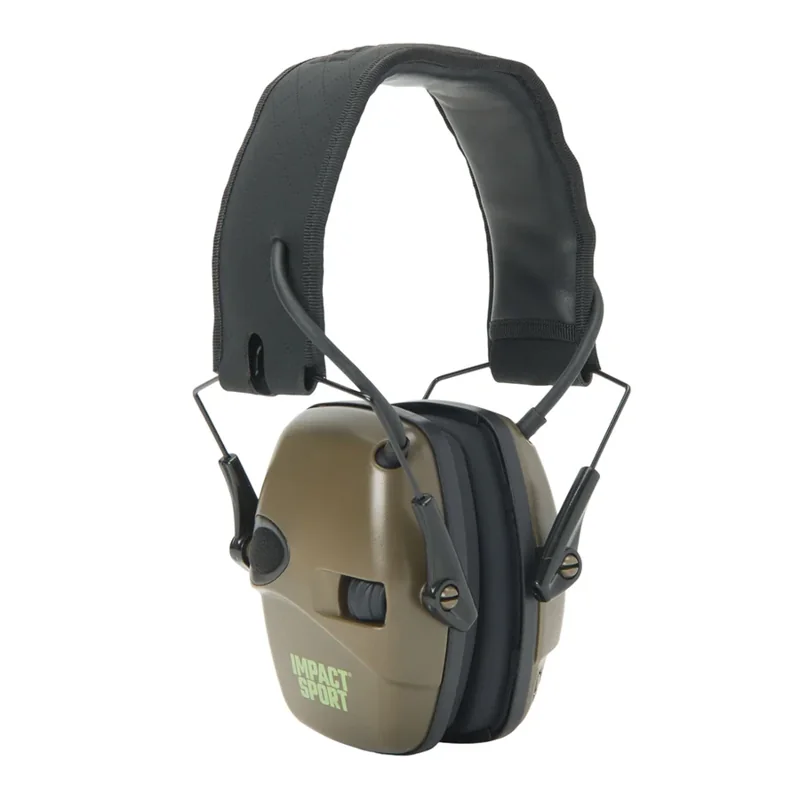
Howard Leight Impact Sport Bluetooth
From the maker's own page, read 2026-09-22A 0.5 millisecond reaction time and 5X amplification that cuts out above 82 dB, with Bluetooth 5.0 and separate volume controls for the phone and the surroundings. Slim cups built to clear a stock.
An over-the-head muff rather than an in-ear device, and at 21 dB its rating sits toward the bottom of this list. The maker's page gives no battery runtime, and Honeywell's own store has it on clearance with one colour already discontinued.
IF YOU'RE DONE WITH MUFFS
In-ear, clear of the cheek weld, 40 hours with the case. $239.99 with a 30-day money-back guarantee.
SEE THE FIELDOPS PRO >>