
Ravine vs Walker's: What Twenty Years of Muffs Got Right
 Mike18 September 2026
Walker's is the pair most hunters already own, usually in muff form, usually bought a decade ago and still in the truck. That makes this less a comparison and more a question about whether to change at all.
Muffs got a lot right. They are cheap, they are simple, the batteries are a shop counter away, and the rating on the box is genuinely high.
Here is where they still win, and where the in-ear form takes it.
1. Ravine FieldOps Pro
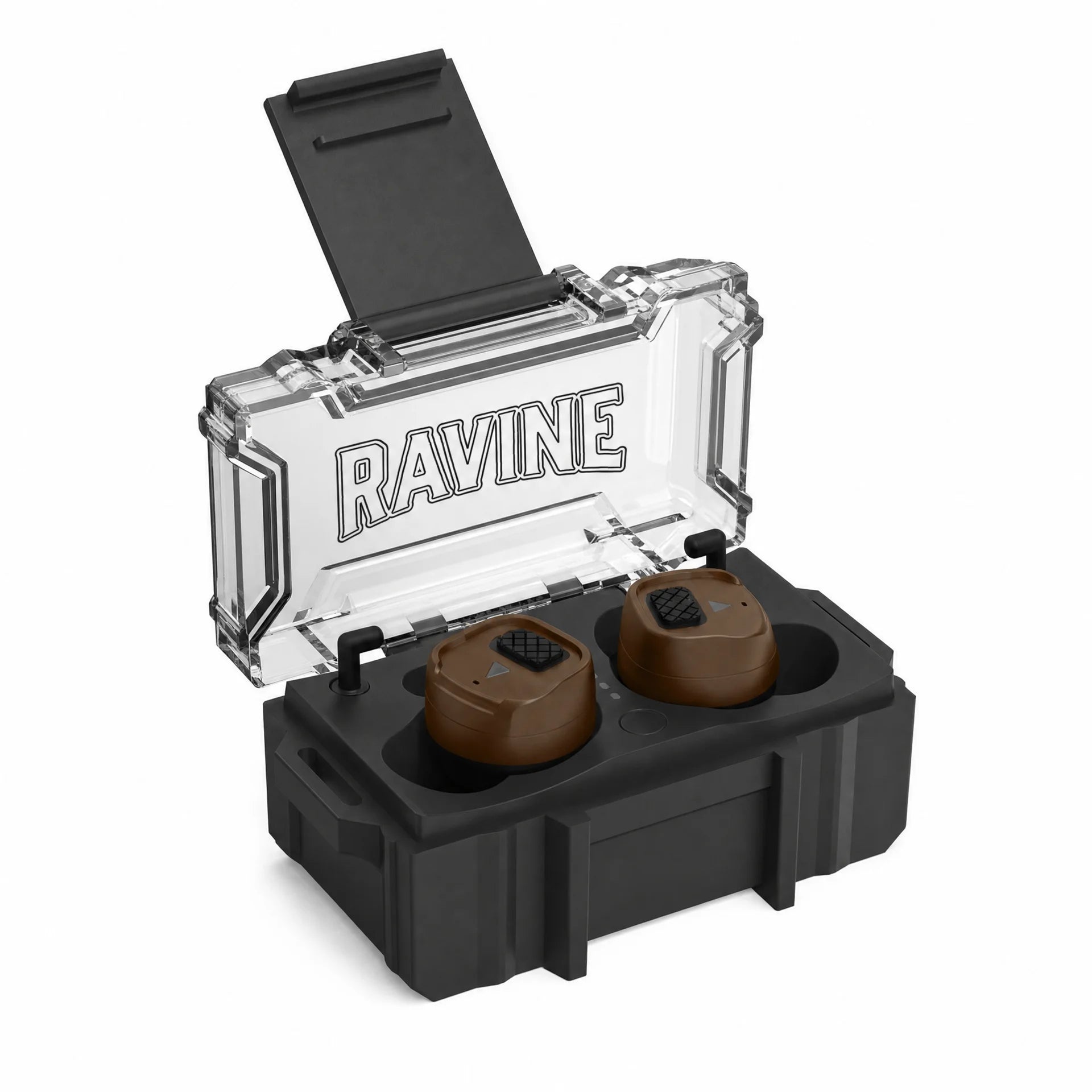
In-ear, no cheek weld, 40 hours with the case, compression in 0.01 seconds.
Against a muff the argument is not the rating, because muffs usually win the rating. It is the cheek weld and the walk. A muff sits between your face and the stock, and it catches on every branch between the truck and the stand. An earbud does neither, and that is the trade: a point or two of rating for a gun that mounts the same way every time.
| Noise Reduction Rating | 31 dB on the Pro, 27 dB on the standard |
| Response time | 0.01 seconds |
| Compression triggers at | 82 dB |
| Amplification | turns up quiet ambient sound in outdoor mode |
| Battery | 40 hours with the charging case |
| Price | $239.99 Pro, $199.99 standard |
Every electronic pair here does the same job in principle: a microphone listens, and when something crosses 82 dB the chip pulls the volume down before it reaches your ear.
What separates them is how fast, and what happens afterwards. Ravine quotes 0.01 seconds. The pairs that feel worst on a range day are not the ones with the lowest rating, they are the ones that stay ducked for a second after the shot, so you lose the conversation and the next bird.
The standard FieldOps is rated 27 dB and the Pro is 31 dB. Those are Noise Reduction Ratings, the figure the EPA requires on the label, measured in a laboratory on a fitted ear.
A rating is a ceiling, not a promise. A pair rated four decibels higher that will not stay in your ear protects you less than a pair rated lower that does. That is the whole argument for the in-ear form, and it is why fit sits above rating in this ranking.
It is also why several makers here publish a range rather than a number: the rating moves with the ear tip you put on.
Amplification is the half people forget. Ravine lifts ambient sound, which is what you want when the thing you are listening for is a twig at forty yards.
This is not a hearing aid and it is not sold as one. It is a microphone and a speaker, tuned for the sounds you go out to hear. If your hearing has changed enough to affect conversation, see an audiologist, and do that whether or not you buy anything here.
The FieldOps Pro is $239.99 and the standard FieldOps is $199.99. Those are the single-pair prices at the cart, not a per-unit price pulled out of a multi-pair bundle.
Both come with a 30-day money-back guarantee, and Ravine attaches no conditions to it.
Hunters who need to hear the approach and still have ears at the end of the season, and anyone who has given up on muffs because of the cheek weld.
If you spend your year on an indoor range and never need to hear anything between strings, a good muff is cheaper and does that job.
THE CASE FOR LEAVING THE MUFFS
In-ear, no cheek weld, 40 hours with the case. $239.99 with a 30-day money-back guarantee.
SEE THE FIELDOPS PRO >>2. Walker's Silencer BT 2.0
Walker's Silencer BT 2.0
From a retailer listing, read 2026-09-18Free Walker's control app pairs the buds and gives per-bud volume, programmable sleep modes, battery charge indication and four sound quality modes.
Bluetooth streaming runs down to 4 hours against 14 hours in suppression mode, so music and protection trade off hard.
STILL THE ONE I REACH FOR
In-ear, no cheek weld, 40 hours with the case. $239.99 with a 30-day money-back guarantee.
SEE THE FIELDOPS PRO >>